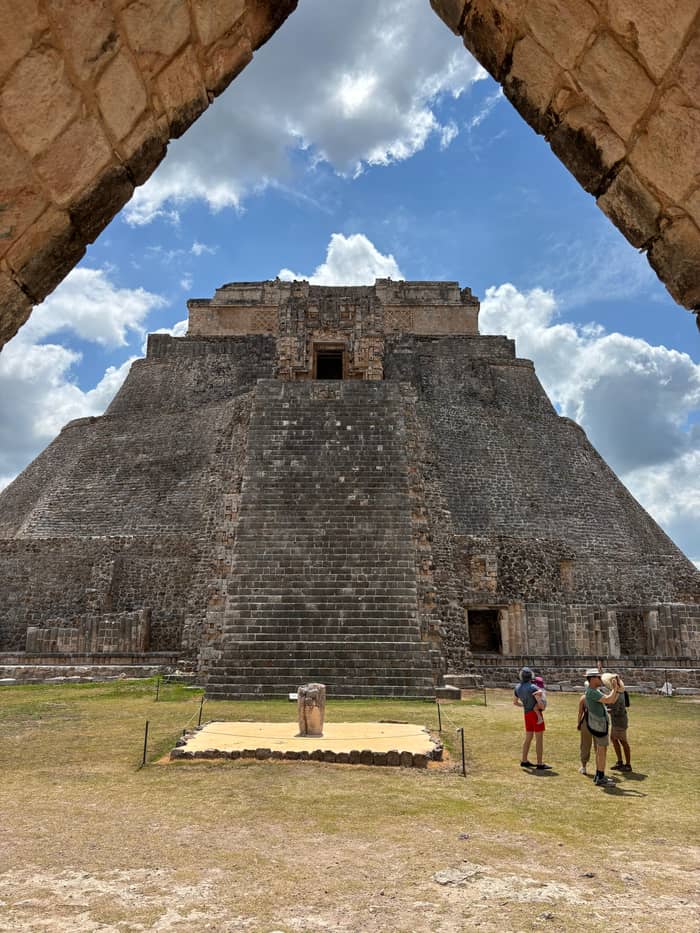
Home day tour
The full day from Merida
Guide, lunch, cenotes
- At the ruins2 hours, guided
- StartsThe visit begins at 9:00
- Pricefrom $91
Guides
Language
Currency
See open datesfrom $91 · no cancel feeCost for your group
3 options compared
Enter your group size and compare what each listing costs for a guided visit to the courtyards.
≈
View≈
View≈
ViewFrom-prices on GetYourGuide, shown at the ECB reference rate. Your exact price is confirmed during booking.
The four buildings around the Nunnery patio, the platform and Venus alignment of the Governor's Palace, the Great Pyramid, the Ball Court and a walking order for the whole group.
Editorial team, uxmaltour.click · Updated November 24, 2026 · 8 min of reading
Quick look
Once you have seen the pyramid, the two groups that decide the rest of a visit are the Nunnery Quadrangle and the Governor's Palace. INAH lists the Nunnery Quadrangle among the most representative buildings of Uxmal,8 and describes the Governor's Palace as ruling over Uxmal and the Puuc from a vast stack of platforms.4 One is a courtyard you walk into, enclosed on four sides. The other is a platform you look up at, open to the sky. Together they show how the city's builders handled both enclosure and display.
The sources do not set one against the other, but they are generous about both. The Yucatan tourism ministry calls the Governor's Palace one of the most beautiful and interesting buildings of Maya architecture,9 and INAH says that many regard it as the finest example of pre-Columbian building anywhere in the Americas.10 Treat those as the official voice of the institutions that look after the site, and as a good reason to give both groups real time on your walk.
What they share is a decorative language. UNESCO says the upper level of a Puuc facade is richly decorated with symbolic motifs, with heads of Chaac over doorways and corners,11 and the tourism ministry describes a plain first level and an extremely ornamented second level with numerous Chaac masks.12 Keep that two-level rule in mind and every facade at Uxmal becomes easier to read, with the upper half carrying the message.
The four buildings
| Building | Size | What INAH adds |
|---|---|---|
| North Building | 81 m wide, on a platform about 100 m long.19,18 | 22 rooms in total, with a throne dated January 20, 909.20,23 |
| East Building | 48 m long and 10.50 m high.21 | Dated October 2, 906.24 |
| South Building | The main facade of the group.15 | Dated April 23, 906, with the door into the patio.24,15 |
| West Building | 54 meters long.22 | Same height and width as the East Building.22 |
All figures are INAH Lugares' own and are shown as written; dates come from inscriptions and carbon 14 work.24,18
INAH says the Spanish colonizers named the complex because they thought the rooms were the residence of Maya priestesses.2 The name is a colonial guess and not a Maya description. The tourism ministry describes a huge courtyard surrounded by four buildings, each with many rooms, like a convent,17 and INAH says the complex rests on an artificial platform carrying four buildings of different levels, shapes and designs.1
The North Building is the largest. INAH puts it on a platform measuring roughly 100 m by 20 m, with a height near 7 m,18 with a staircase 30 m wide leading to a building that is 81 m wide.19 It is divided into 11 rooms per bay, 22 in total.20 Those numbers make it the stage of the courtyard: it is set higher than the other three and wider than any of them, and the whole patio turns toward it.
The other three are smaller but not plain. INAH gives the East Building as 48 m long and 10.50 m high,21 the West Building as 54 meters long,22 and says the South Building forms the main facade, with the door that gives access to the patio.15 Walk in through the South door and the courtyard opens around you, with the North Building's platform ahead. Take a minute in the middle of the patio before you start reading individual doorways, since the four facades face each other.
Length and width
The decoration at the Nunnery is varied. INAH lists latticework, serpent motifs, masks of Chaac and Tlaloc, jaguars, owls, human figures and huts as the main motifs.25 The Tlaloc masks matter to historians because INAH ties the arrival of Tlaloc imagery at Uxmal to a conquest by Chichen Itza around 874 AD.28 A visitor with a guide can look for those foreign motifs among the Chaac masks that belong to the local tradition.
The dates are unusually precise. INAH says inscriptions and carbon 14 dates give the East Building a date of October 2, 906 and the South Building April 23, 906,24 while the throne at the start of the North Building staircase carries January 20, 909.23 These dates sit close to the year 900, which INAH gives as the height of Uxmal before a slow decline set in.29 A guide can help you match each date to its doorway, and the exercise is a quick way to feel how close in time the separate buildings were.
The story did not end with the builders. INAH says the foundation of the South Building was later modified and shows remains of small C-plan buildings dated between 950 and 1150.30 In plain terms, people kept living in and around the old rooms after the grand period had passed. For a visitor that is a reminder that these ruins were a lived-in place for generations, with small later buildings among the earlier rooms.
Pick your first stop
Name the thing that draws you most and the part of the group to give time to is shown beside it.
If I love carved detail
The Nunnery patio
INAH lists latticework, serpents, Chaac and Tlaloc masks, jaguars and owls on its facades.25
If I want the big view
The palace terrace
The palace dominates Uxmal from its enormous platforms.4
If I am curious about astronomy
The Governor's Palace
It is aligned with Venus and the solstices.5
If I want something stepped and tall
The Great Pyramid
It is a truncated pyramid with nine staggered bodies.6
If I like sport and ritual
The Ball Court
Its courtyard is 34 meters long and the court was used for 260 years.7,26
If I only have a short visit
Nunnery then palace
The ministry's record suggests a visit of about 2 hours, enough for these two.27
Time with the courtyards
Home day tour
Guide, lunch, cenotes
Site guide
The ruins only
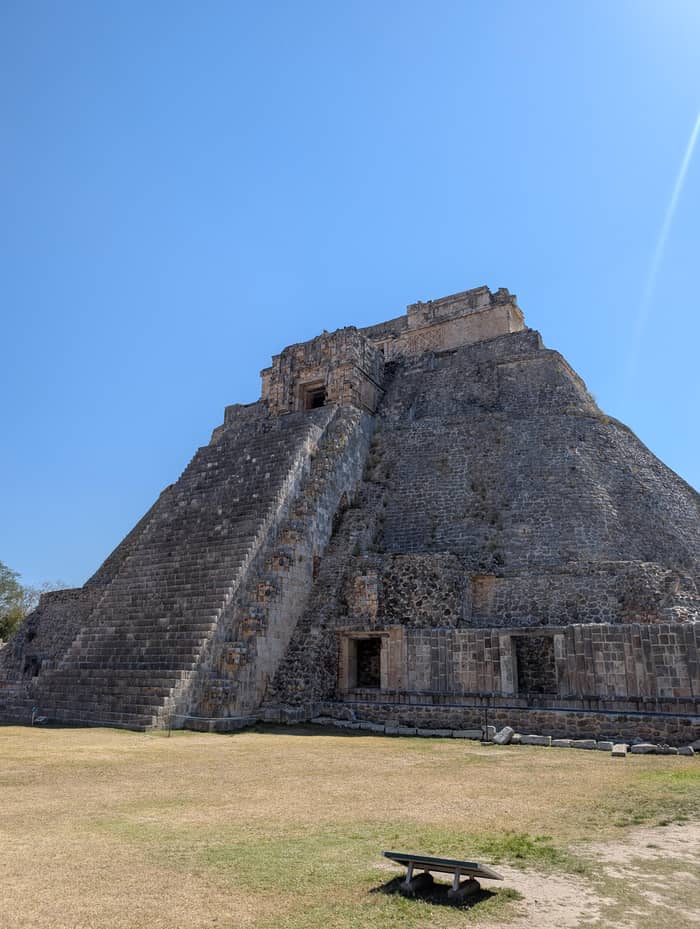
Combined day
Two ruined cities
The palace is the building that makes people stop. The tourism ministry says it is almost 100 meters long and 9 meters high,3 and INAH's World Heritage page gives the upper facade as 100 m.36 A great platform carries three self-standing buildings joined by vaulted galleries,9 so photographs of the front show a long, calm line of stone. The palace is also written as the House of the Governor in some guides.
The facade is carved with lattices, Chaac masks and representations of rulers on different planes,37 and the whole building is placed with astronomy in mind. INAH says the palace as a whole is aligned to follow the apparent path of Venus and the solstice positions of the Sun.5 UNESCO supports the larger idea: the plan of Uxmal ignores a strict grid and follows the sky, with Venus among its reference points.38
A practical consequence follows from the platform. INAH describes the palace as ruling over the site from a vast stack of platforms,4 so the best approach is to walk to its terrace and turn around. From there you see the Magician's pyramid, the Nunnery and the Great Pyramid in the right relationship. Give the palace the unhurried part of your visit and let the view do the work; a few quiet minutes there are worth more than a rushed look at three more buildings.
A route through the group
Gate
The zone opens its gate at 8:00 and shuts at 16:00 on INAH's list, so an early start is possible.13
Courtyard of birds
Start beside the Magician's pyramid, which INAH reads as the sky joined to the earth courtyard.14
Nunnery
The South Building forms the main facade and holds the door into the patio.15
Palace terrace
The Governor's Palace dominates Uxmal from its enormous platforms.4
Neighbours
A short walk covers a nine-body pyramid and a court with a 34-meter courtyard.6,7
Finish
The crest of the House of the Doves is built from nine triangular units.16
Three more buildings sit within a short walk of the palace. INAH describes the Great Pyramid as a truncated quadrangular pyramid with nine staggered bodies,6 and says the temple on top is called the Temple of the Macaw because the macaw is the main motif of its facade.39 UNESCO also lists the Ball Court and the House of the Tortoises among the most important buildings of the site.40
The Ball Court is smaller than the legend of the game suggests. INAH says its courtyard is 34 meters long and 10 meters wide,7 and that the rings carry a hieroglyphic inscription dated 649.41 INAH concludes from the evidence that the court was used for 260 years.26 The figures are worth quoting to a guide, since they help you picture a working court in the middle of the city and not just a stone alley.
The House of the Turtles is the quiet building of the group. INAH says it was built on an extension of the Great Platform around 900 AD,42 with a frieze of sculpted turtles, animals associated with water and the creation of the world.43 After the palace it can feel plain, which is precisely the point: its ornament is quieter than the palace's, and the turtles repeat the theme of water that runs through the whole site.
Video
MegalithomaniaUK on YouTube · Nothing is fetched until you hit play.
It is considered by many to be the most extraordinary example of pre-Columbian architecture in all of the Americas.
On the day
The ministry's experience record sets a visit at about 2 hours,27 and the full-day tour allots the Uxmal stop 2 hours with a certified guide, beginning at 9:00. That is enough for the pyramid, the Nunnery, the palace and a pass by the neighbours if you walk steadily. If you came by yourself and want a longer visit, a separate site-guide listing offers a 2-hour guided visit from the ticket office.
A sensible order follows the way the city was arranged. Begin at the Magician's pyramid and the Quadrangle of the Birds, then enter the Nunnery by its South Building door, then climb toward the Governor's Palace and finish on the terrace with the Great Pyramid and the Ball Court behind you. That sequence keeps the long views for the end, when you have the legends and the numbers in your head. INAH names the Nunnery and the House of the Doves among the most representative buildings, so do not skip the walk to the latter.8
The House of the Doves wears a distinctive crest. INAH says the openwork was used for nesting pigeons, which gave the building its name,44 and describes the crest as nine triangular fretworked units set on a row of pillars.16 It is a good last stop for a photograph, since the crest reads clearly against the sky. Whatever order you choose, check the site hours before you go: INAH lists 8:00 to 16:00.13
With less time, choose by theme. For symmetry and carving, spend your minutes in the Nunnery patio, where the four facades face each other. For scale and the sky, go to the palace terrace. For the Maya view of the universe, pause at the Quadrangle of the Birds, which INAH reads together with the pyramid as one sacred space.14 A shortlist like that protects the day from the common mistake of treating every building as equally important.
Pay attention to what is missing as well as what is there. UNESCO reads the town wall as a sign of conflict with other urban centres,45 and INAH lists the monuments protected behind that wall, beginning with the Governor's Palace.46 The courtyards you walk through were the protected core of a city that expected trouble, not a park laid out for leisure. That context makes the controlled entrances of the Nunnery easier to understand.
Finally, consider the evening. The Ecos de Uxmal night event is run by the Yucatan state government, INAH notes,47 and the first listed start is 19:30.35 If you are staying nearby, an evening visit adds light to the same stones. For a day trip from Merida, the daytime walk above is the core of the visit and fits within the 2 hours the sources give. Keep a little time in reserve, since the walk between groups is longer than the plan on paper suggests.
FAQ
INAH says the colonizers thought the rooms were the residence of Maya priestesses.2
The tourism ministry says it is almost 100 meters long and 9 meters high, on a great platform.3
INAH says the palace as a whole is aligned to follow the apparent path of Venus and the solstice positions of the Sun.5
INAH says four buildings with different levels and designs are deployed on the platform.1
INAH gives the courtyard as 34 meters long and 10 meters wide.7
Around 2 hours, since the ministry's record gives that for a visit and the full-day tour allots the same at Uxmal.27
Sources
Planning a day at Uxmal from Merida? Ask a real person here.